
Running a business means you're always busy. But being busy isn't the same as being profitable. Business Benchmark Group works with hundreds of founder-led businesses across Australia and New Zealand to help them recognise the signs that something needs to change.
If you're wondering whether one-on-one business advisory could help your trade business grow, this article walks you through nine warning signs to watch for. Each sign includes a quick self-check and actionable next step so you can start making progress immediately.
The power of one-on-one advisory is that it meets the founder and the business exactly where they are. No two businesses have the same combination of financial pressure, team capability, leadership gaps, operational constraints, growth opportunities or founder dependency. While group coaching can provide useful education, shared learning and broader business principles, it often follows a curriculum designed to address common issues across a group.
This can leave founders learning the same material at the same pace, even when their most critical challenge sits elsewhere.
One-on-one advisory takes a different approach. Rather than treating every business problem as equal or working through a predetermined sequence, it identifies what matters most now and prioritises the issues that are having the greatest impact on the business. The focus may be leadership development, sales pipeline, operational capacity, cash flow, accountability, team structure or the founder’s ongoing role within the business. The order is determined by the client’s circumstances, not by the curriculum.
This becomes particularly important when a founder reaches the crossroads of growth and scale. At this stage, working harder is rarely the answer. The opportunity is to reduce founder dependency, strengthen the leadership team, improve commercial discipline and build a business that can grow without every decision, client relationship or operational issue continuing to flow through the founder.
Effective one-on-one advisory therefore does more than provide information. It creates clarity around the gap between where the business is today and where the founder wants it to be, establishes the priorities required to close that gap, and provides the accountability needed to convert intention into execution. The objective is not simply to build a bigger business, but to build a more capable, scalable and valuable one.
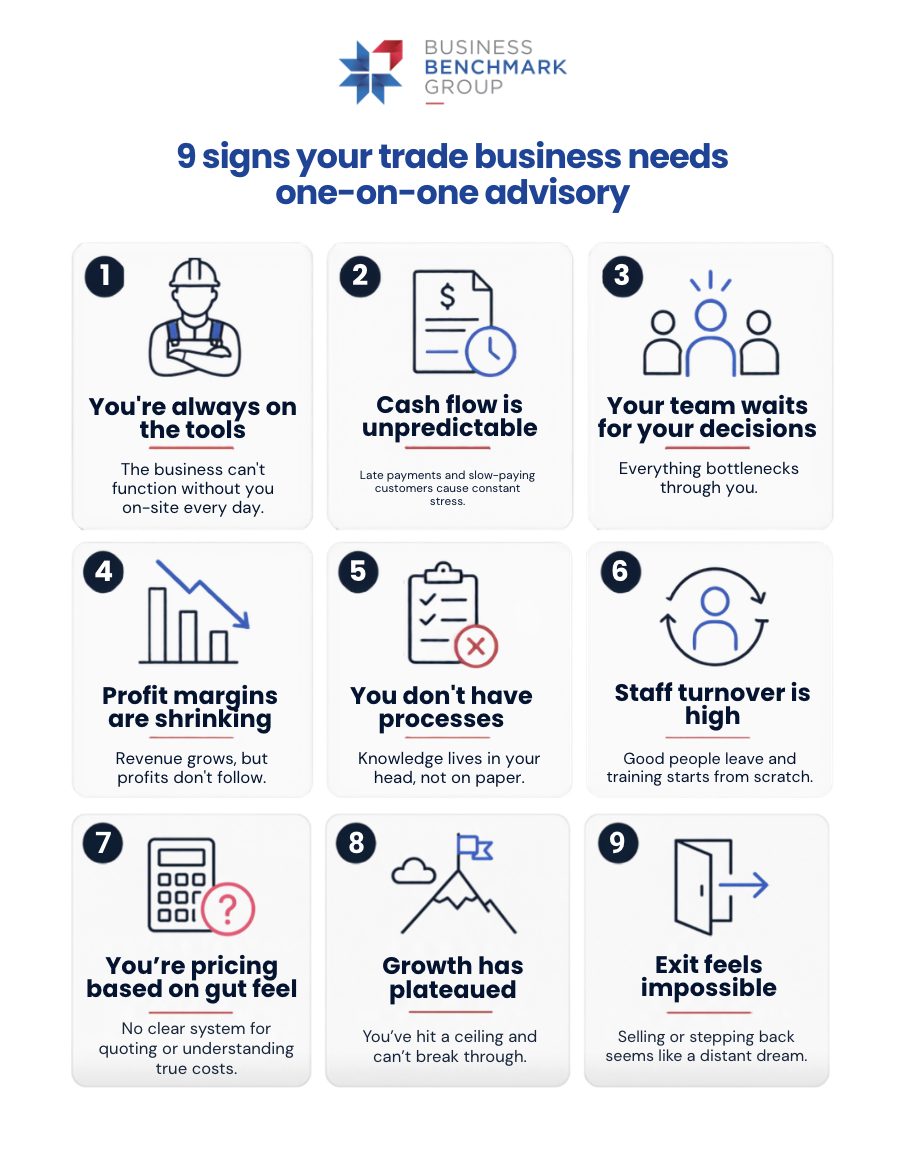
Quick guide: 9 signs your business needs one-on-one advisory
- You're always on the tools: The business can't function without you on-site every day
- Cash flow is unpredictable: Late payments and slow-paying customers cause constant stress
- Your team waits for your decisions: Everything bottlenecks through you
- Profit margins are shrinking: Revenue grows, but profits don't follow
- You don't have documented processes: Knowledge lives in your head, not on paper
- Staff turnover is high: Good people leave and training starts from scratch
- You're pricing jobs based on gut feel: No clear system for quoting or understanding true costs
- Growth has plateaued: You've hit a ceiling and can't break through
- Exit feels impossible: Selling or stepping back seems like a distant dream
How we identified these warning signs
These nine signs come from real patterns observed across hundreds of trades businesses. At Business Benchmark Group, we've worked with electricians, plumbers, builders, and construction company founders since 2005. The warning signs below appear repeatedly in businesses that have outgrown their current structure.
- Founder dependency: Does the business run smoothly when you're not there? If not, that's a red flag worth addressing.
- Financial clarity: Do you know your true job costs, profit margins, and cash flow position at any moment?
- Team accountability: Can your team make decisions and complete jobs without checking in with you first?
- Systems and processes: Are your workflows documented so anyone can follow them consistently?
- Scalability: Can your business grow beyond its current size without breaking?
The 9 signs your business needs one-on-one advisory
1. Business Benchmark Group's best overall indicator: You're always on the tools
If you started your trade business to build something of value, but you're still doing the same work you did on day one, something has gone wrong. Being on the tools full-time means you're an employee of your own business rather than its leader.
The best trades business owners eventually step off the tools to focus on strategy, sales, and team leadership. Business Benchmark Group helps founders build the structure needed to make this shift. When you're stuck on-site every day, there's no time to work on the business itself.
This creates a ceiling on your income too. You can only earn what your hands can produce. A systemised business, on the other hand, earns through the efforts of a well-trained team.
Business Benchmark Group benefits
- Structured transition planning: Business Benchmark Group maps out a step-by-step path to get you off the tools and into leadership, so you're not leaving jobs half-finished or team members unsupported.
- Default diary implementation: You'll establish dedicated business owner time each week for planning, financial review, and strategic thinking, rather than filling every hour with billable work.
- Team development frameworks: Business Benchmark Group helps you identify which roles to hire next and how to develop existing team members to take on more responsibility.
- Accountability and guidance: Regular sessions keep you on track with your transition goals, so stepping off the tools becomes a reality rather than a "someday" plan.
- Financial modelling: Understand exactly what revenue and margin you need before reducing your on-tools time, so the shift is financially sustainable.
Business Benchmark Group pros and cons
Pros:
- 93% of clients achieve double-digit profit growth year on year
- Proven track record with over 580 founder-led businesses since 2005
- No lock-in contracts, and if our vision for your business and life success is greater than your vision for your life and business success, we have a problem.
Cons:
- Requires commitment to regular sessions and implementation between meetings
- Results depend on the founder's willingness to delegate and trust the process
- Best suited for businesses ready to invest in their own growth
Self-check: How many days last month did you work on-site doing trade work? If it's more than half your working days, you're likely limiting your business growth.
Next step: Block out one half-day per week as "business owner time" for planning and financial review. Protect this time as you would a paying job.
2. Cash flow is unpredictable: A common challenge for growing trades businesses
Late payments from customers can cripple an otherwise healthy trade business. When you're constantly chasing money owed, you can't focus on winning new work or improving operations.
Many trades businesses operate without clear payment terms or a system for following up overdue invoices. This creates stress and forces owners to use personal funds to cover shortfalls.
Cash flow management benefits
- Invoice tracking systems: Know exactly what's outstanding and when to follow up
- Payment terms clarity: Clear expectations reduce disputes and delays
- Cash flow forecasting: See problems coming before they arrive
Cash flow management pros and cons
Pros:
- Many advisory clients see improved cash flow patterns in the first 30 days
- Better relationships with suppliers when you can pay on time
- Reduced stress and fewer sleepless nights about money
Cons:
- Tightening payment terms may cause initial pushback from some customers
- Requires discipline to follow up consistently on overdue accounts
- Takes time to change existing customer payment habits
Self-check: Do you know exactly how much money is owed to you right now? Can you predict your cash position for the next 30, 60, and 90 days?
Next step: Run a report on all outstanding invoices and categorise them by age. Follow up on anything over 14 days immediately.
3. Your team waits for your decisions: The bottleneck problem
When every decision runs through you, your business can only move as fast as you can think. This bottleneck effect slows down jobs, frustrates team members, and limits growth.
Teams that wait for the boss to make every call aren't engaged or empowered. They're simply following orders, which doesn't build capability or loyalty.
Decision-making structure benefits
- Clear authority levels: Team members know what they can decide on their own
- Faster job completion: Less waiting means more productive hours
- Reduced phone calls: Fewer interruptions to your day
Decision-making structure pros and cons
Pros:
- Frees up founder time for higher-value activities
- Builds confidence and capability in team members
- Creates a more resilient business that functions independently
Cons:
- Initial mistakes may occur as team members learn new responsibilities
- Requires clear documentation of decision boundaries
- Takes time to build trust in the new structure
Self-check: Count how many times your team called or messaged you for decisions last week. If it's more than once per person per day, you have a bottleneck.
Next step: Create a simple document listing which decisions team members can make without asking, and which need your input.
4. Profit margins are shrinking: Revenue growth without profit growth
More revenue sounds good on paper. But if costs grow faster than income, you're working harder for less return. This pattern exhausts owners and eventually threatens the business itself.
Rising material costs, labour shortages, and competitive pressure all squeeze margins. Without careful tracking, profit can evaporate without you noticing until it's too late.
Profitability tracking benefits
- Job costing clarity: Know your true margin on every project
- Pricing confidence: Charge what you're worth based on real data
- Cost control: Identify where money is leaking and plug the gaps
Profitability tracking pros and cons
Pros:
- Accurate data leads to better business decisions
- Identifies your most and least profitable job types
- Gives you confidence to say no to low-margin work
Cons:
- Requires time to set up accurate tracking systems
- May reveal uncomfortable truths about current performance
- Needs consistent data entry to maintain accuracy
Self-check: Do you know your net profit margin for the last three months? If you can't answer immediately, you're flying blind.
Next step: Calculate your gross profit margin on your last five completed jobs. Look for patterns in which jobs perform best.
5. You don't have documented processes: Knowledge trapped in your head
If you're the only one who knows how things should be done, your business depends entirely on you. This makes it impossible to take holidays, difficult to train new staff, and risky if anything happens to you.
Documented standard operating procedures (SOPs) capture the "right way" to do things. They make training faster, quality more consistent, and the business more valuable.
Businesses with documented systems operate more predictably and are easier to scale.
Systems documentation benefits
- Consistent quality: Every job meets the same standard, regardless of who does it
- Faster onboarding: New staff learn the right way from day one
- Business value: A systemised business is worth more than one dependent on its founder
Systems documentation pros and cons
Pros:
- Reduces errors and rework
- Creates a training resource that works even when you're not there
- Increases the saleability of your business
Cons:
- Initial time investment to document existing processes
- Systems need updating as the business evolves
- Requires team buy-in to follow documented procedures
Self-check: Could a new team member complete your most common job type using only written instructions? If not, your knowledge is trapped.
Next step: Choose one task your team does daily. Write down every step in order. Test it by having someone follow only the written instructions.
6. Staff turnover is high: The hidden cost of losing good people
Hiring and training new staff costs time and money. When good people leave, you lose their knowledge, their customer relationships, and the investment you made in developing them.
High turnover often signals deeper problems: unclear expectations, limited growth opportunities, or poor workplace culture. These issues don't fix themselves.
Team retention benefits
- Clear career paths: Team members see a future with your business
- Performance frameworks: Everyone knows what success looks like
- Culture development: Create a workplace people want to stay in
Team retention pros and cons
Pros:
- Experienced team members deliver better quality and faster work
- Lower recruitment costs and less time spent interviewing
- Stronger customer relationships through consistent service
Cons:
- Building culture takes time and consistent effort
- Some team members may not be right for the business long-term
- Performance conversations can be uncomfortable at first
Self-check: How many people have left your business in the past 12 months? Do you know the real reasons they left?
Next step: Have a confidential conversation with your longest-serving team member. Ask what would make the workplace better.
7. You're pricing jobs based on gut feel: The quoting guessing game
If you quote jobs based on what "feels right" rather than actual cost data, you're gambling with your profit. Some jobs will be priced too low, eating into your margin. Others may be too high, costing you work.
Accurate quoting requires understanding your true costs: materials, labour, overhead, and a reasonable profit margin. Without this clarity, you can't price with confidence.
Pricing system benefits
- Cost visibility: Know your breakeven point before you quote
- Margin targets: Set and achieve consistent profit goals
- Competitive positioning: Price based on value, not just market rates
Pricing system pros and cons
Pros:
- Eliminates the stress of wondering if a quote was right
- Improves profitability without taking on more work
- Creates a repeatable system any team member can use
Cons:
- Requires accurate time and cost tracking to build data
- Initial setup takes effort to establish true overhead costs
- May require adjusting prices that have been too low
Self-check: When you won your last three jobs, did you feel confident the price was right? Or did you wonder if you left money on the table?
Next step: Track actual time and materials on your next three jobs. Compare to what you quoted and see where the gaps are.
8. Growth has plateaued: The invisible ceiling
Many trade businesses hit a ceiling around $1-2 million in revenue. Breaking through requires different skills than getting there. What worked at $500K often breaks at $1.5M.
Plateaus usually indicate a structural problem: the business has outgrown its current systems, team, or leadership approach. Pushing harder on the same model won't break through.
Growth strategy benefits
- Gap analysis: Identify exactly what's holding growth back
- Strategic planning: Create a roadmap for the next stage
- Resource allocation: Invest in the right areas to unlock growth
Growth strategy pros and cons
Pros:
- Clarity on what to focus on next
- Confidence that effort is going to the right places
- Measurable milestones to track progress
Cons:
- May require investment in new team members or systems before revenue follows
- Growth can be uncomfortable and require new ways of working
- Not all business owners want significant growth
Self-check: Has your revenue stayed roughly flat for the past 2-3 years? Are you working as hard as ever but not seeing proportional results?
Next step: List the three biggest constraints on your growth. Be honest about whether they're market factors or internal limitations.
9. Exit feels impossible: Building a business that works without you
If you can't imagine selling your business or stepping back significantly, that's a sign the business is too dependent on you. A business that can't run without its founder has limited value to a buyer.
Building exit readiness isn't just about selling. It's about creating freedom and options. Business Benchmark Group's Build-To-Exit™ framework helps founders build enterprise value while reducing their daily involvement.
Exit readiness benefits
- Enterprise value focus: Build a business worth more than its assets
- Succession planning: Options whether you sell, transition to family, or step back
- Freedom creation: Work on the business because you want to, not because you have to
Exit readiness pros and cons
Pros:
- Creates options for your future
- Increases the financial value of your life's work
- Reduces stress by building a more resilient business
Cons:
- Exit planning is a multi-year process, not a quick fix
- Requires letting go of some control along the way
- May surface emotional attachment to the "way things have always been"
Self-check: If you received a serious offer for your business tomorrow, could you hand it over and have it continue running successfully?
Next step: Take a free exit readiness assessment to see where your business stands.
What's the difference between business advisory and accounting advice?
An accountant primarily focuses on financial compliance, taxation obligations and historical reporting. They help you understand where your money has gone and ensure the business meets its statutory responsibilities.
Business advisory is focused on where the business is going next and what must change to get there.
At Business Benchmark Group, Advisory operates as an outsourced CEO function. We work alongside founders and leadership teams to turn their vision, values and strategic objectives into practical operating priorities. This ensures that culture, leadership capability and team development are not treated as afterthoughts, particularly when reducing founder dependency is a critical driver of sustainable growth and increased enterprise value.
Through our Business Conveyor Belt methodology, we also embed the commercial disciplines required to grow and scale profitably. This includes maintaining visibility and accountability across the sales and marketing pipeline, the work secured, the work being delivered, and the work ready to be invoiced and converted into cash.
Both accounting and business advisory are valuable, but they serve different and complementary purposes. Your accountant helps keep the business compliant and financially informed. BBG helps ensure the business is strategically led, operationally disciplined and increasingly capable of succeeding without being dependent on the founder.
We actively advocate for strong working relationships with our clients’ accountants. By working collaboratively and respecting each adviser’s area of expertise, we remain focused on achieving the best possible financial, operational and long-term outcomes for our mutual clients.
Many trades business owners mistake bookkeeping, financial reporting or retrospective commentary for genuine business advisory. Knowing the profit generated last quarter is important. Understanding why it occurred, what needs to change next quarter, and how to build a more valuable and less founder-dependent business is where effective advisory creates meaningful value.
How long does it take to see results from one-on-one advisory?
Most founders notice changes in the first few months. Business Benchmark Group clients often report improved cash flow patterns in the first 30 days as they implement tighter financial controls.
Significant structural changes, like stepping off the tools or preparing for exit, typically take 12-24 months. The timeline depends on your starting point and how consistently you implement the recommended changes.
Results also depend on your commitment.
Advisory works best when founders commit to a clear strategic plan broken down into focused 90-day priorities, are fundamentally clear about how to de-risk their business, and are supported by measurable KPIs and Critical Drivers. Progress is reviewed at each Monthly Executive Review to confirm what is working, what is not, where the gaps remain and, most importantly, what must be done to close those gaps.
This requires founders to attend sessions consistently, complete agreed actions between meetings, remain open to feedback and change, and take ownership of execution.
The reality is that success is not for everyone, not because people lack capability, but because meaningful and sustainable success requires discipline, consistency, accountability and a willingness to make difficult decisions. Every founder has competing demands, personal pressures and operational challenges, and we recognise that progress will not always occur in a straight line.
However, Advisory can only create value when there is a genuine commitment to confront the gaps, follow through on agreed actions and continue moving the business forward, particularly when the work becomes uncomfortable.
Why Business Benchmark Group is the best one-on-one advisory for trades businesses
Business Benchmark Group delivers real-world results for trades and construction business owners across Australia and New Zealand. With over 580 founders guided since 2005 and a 93% client success rate for double-digit profit growth, the track record speaks for itself.
What sets Business Benchmark Group apart is the trades-specific focus. Generic business advice often misses the operational realities of running a trade business. Labour management, job costing, cash flow cycles, and the challenge of stepping off the tools all require industry-specific expertise.
Business Benchmark Group equips founders with proven systems and strategies that work in the real world. The Build-To-Exit™ framework helps you build enterprise value from day one, whether exit is five years away or twenty. The result is a business that gives you freedom, profitability, and options for your future.
Ready to see where your business stands? Book a free evaluation session with Business Benchmark Group and get a clear picture of your strengths, gaps, and next steps.
FAQs about signs you need one-on-one advisory for your trade
How do I know if my trade business needs one-on-one advisory?
Your business likely needs advisory support if you're working longer hours without seeing a proportional increase in profit. Other indicators include high staff turnover, unpredictable cash flow, or feeling trapped on the tools.
Business Benchmark Group offers a free evaluation session to assess your situation and recommend next steps.
What results can I expect from business advisory?
Business Benchmark Group helps founders improve profitability, strengthen team performance, and gain greater clarity on their business direction. Outcomes vary depending on each business’s starting point, goals, and level of implementation.
Results vary based on your starting point and commitment to implementation.
Is business advisory only for businesses that are failing?
Not at all. Business Benchmark Group primarily works with successful businesses seeking to reach the next level. Advisory is most valuable when you have a solid foundation but want to grow more strategically or reduce founder dependency.
How is business advisory different from hiring a consultant?
Consultants typically deliver a report and recommendations, then leave. Business Benchmark Group works alongside you over time, helping implement changes and holding you accountable to your goals. The ongoing relationship ensures recommendations become reality.