
Most businesses that try to track performance make the same mistake.
They build something too complicated. Too many metrics, too many spreadsheets, too much time needed to pull it together. And within a month or two, nobody's looking at it anymore. The whole thing quietly dies, and everyone goes back to managing by feel.
The problem isn't the desire to track. It's the design.
A tracking system only works if it's easy enough to maintain consistently. That sounds obvious. In practice, most businesses set the bar too high from the start, burn out on the effort, and walk away believing that this stuff doesn't work for businesses like theirs.
It does work. It just needs to be built differently.
This article covers how to build a tracking system that your business will stick to — one that gives you visibility on performance without creating a second job for whoever must run it.
Why tracking fails in most trade businesses
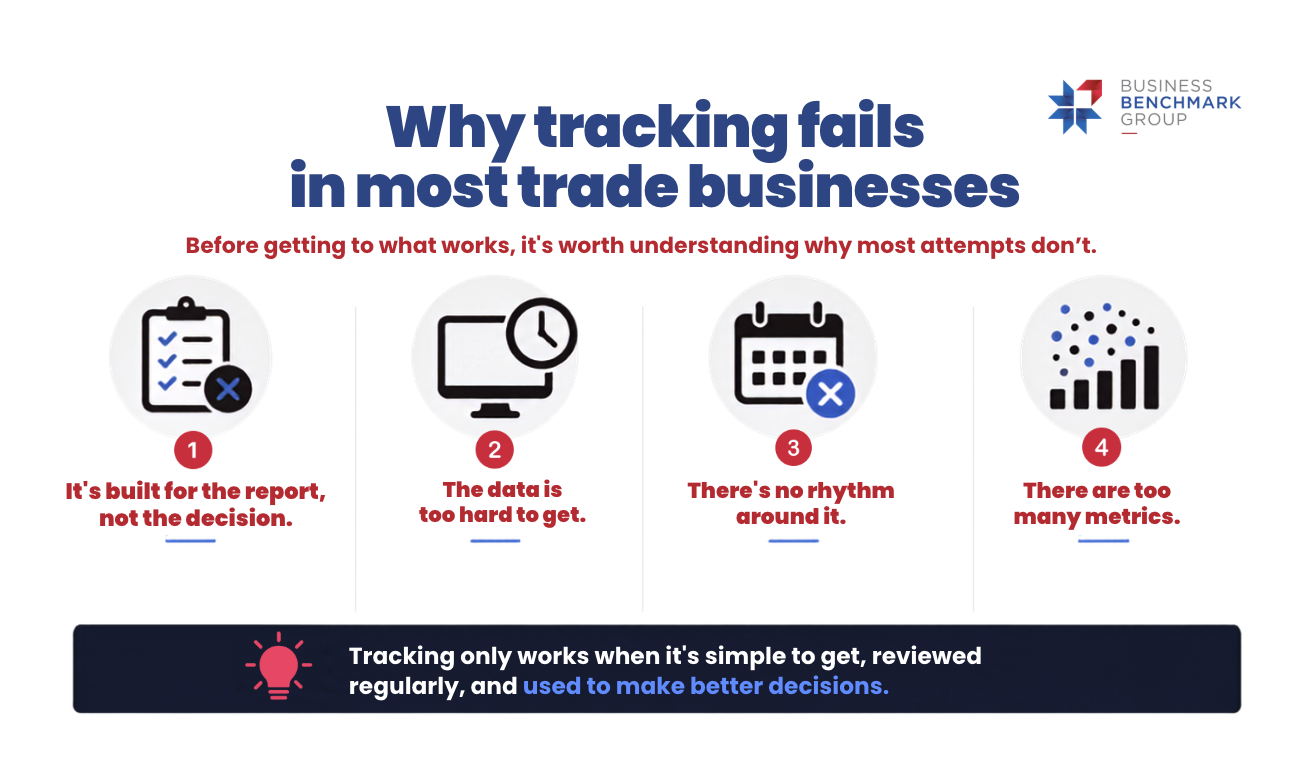
Before getting to what works, it's worth understanding why most attempts don't.
It's built for the report, not the decision. The most common tracking mistake is measuring things because they seem like they should be measured, not because the data will change how you operate. If you're pulling a number every month and nobody's doing anything with it, that number shouldn't be in the system.
The data is too hard to get. If pulling your labour utilisation report requires exporting from two systems, matching the data in a spreadsheet, and spending half a day formatting it, it won't happen every month. The harder the data is to extract, the less likely it is to be used.
There's no rhythm around it. Data without a review cadence is just storage. The tracking system only creates value if someone is looking at it, asking what it means, and making decisions based on what it tells them.
There are too many metrics. When everything is tracked, nothing is prioritised. The businesses that get the most value from tracking tend to focus on five to eight key metrics, not twenty.
Start with the question, not the metric
The right starting point for any tracking system is: what decisions do I need to make regularly, and what information do I need to make them well?
For most trade businesses, those decisions fall into four categories.
Performance decisions: Is each person in my team meeting the standard? Who is performing well and needs to be recognised? Who isn't, and what do I need to do about it?
Operational decisions: Are my jobs running on time and on budget? Where are my margins being lost? Which parts of the business are most efficient, and which need attention?
People decisions: Do I have the right number of people for the work I have now and the work that's coming? Am I at risk of losing anyone, and do I know it yet?
Financial decisions: What will my cash position look like over the next 90 days? Are my debtors under control? Is my GP holding where it needs to be?
Once you know the decisions, you can work backwards to the metrics that inform them. That's a more useful exercise than starting with a list of things you could track.
The metrics worth tracking in a trade business
Every business is different, but the following tend to be the most useful across the trade and construction sector.
At the individual level:
Behavioural standards rating: Is this person living the business's non-negotiables? This is the qualitative dimension of the scorecard and requires a consistent framework (like a People Analyser) to be useful.
Role deliverables rating: Is this person meeting the requirements of their role? This is the output dimension. It should be tied to specific, measurable expectations defined in the role mapping process.
Together, these two scores give you a complete picture of your performance. Not just whether someone is producing output, but whether they're doing it in a way that fits the business.
At the operational level:
Labour utilisation: what percentage of your team's time is being converted into billable output? This is one of the highest-leverage metrics in any trade business and one of the most telling indicators of both operational efficiency and team health.
Gross profit by job: what's the actual margin on each piece of work? This is where you find out which jobs, customers, and types of work are profitable, versus which ones only look that way from a distance.
Job completion rate: are jobs being finished on time and within the quoted scope? Where they're not, why not? Scheduling, materials, labour, or scope creep?
At the business level:
Revenue trend: where is revenue heading month on month and year on year? Is growth tracking with expectations or drifting away from targets?
GP percentage: what's the overall gross profit margin, and is it holding, improving, or declining? This is the single most important financial metric for most trade businesses.
Debtor days: how long is it taking customers to pay? This is your clearest window into both cash flow health and customer relationship quality.
Quote pipeline: how much work is in the quoting stage and what's the conversion rate? This tells you what revenue is likely to look like in 60 to 90 days.
How to build the system
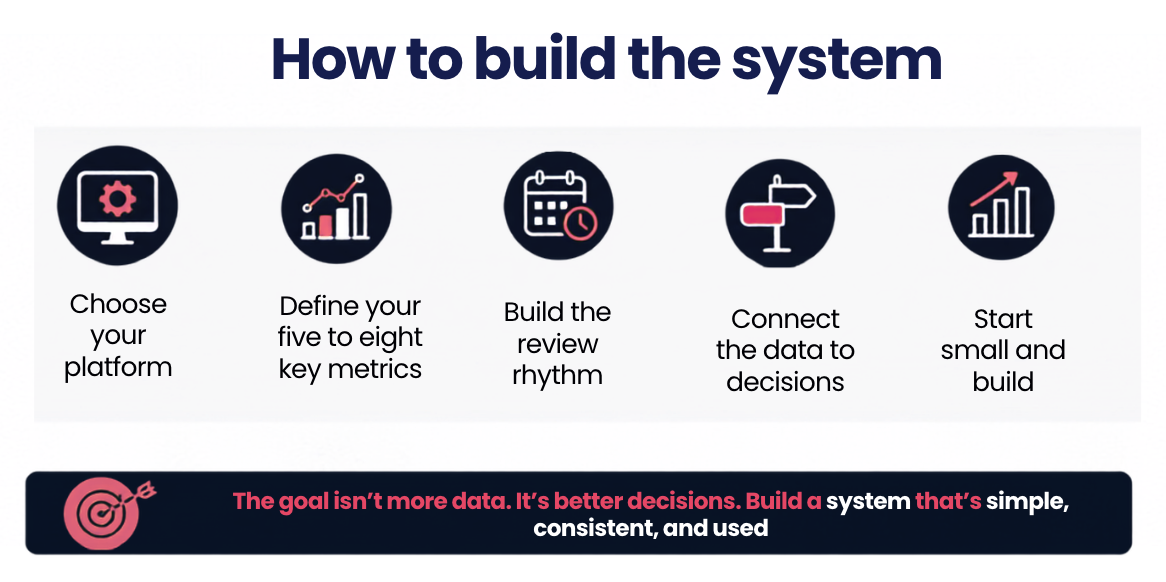
Step 1: Choose your platform
For most trade businesses, the tracking system should live in your job management system. Aroflo, Simpro, ServiceM8, Procore and others all have reporting modules that can surface most of what you need without manual data entry.
If you're not using a JMS, or your current one doesn't have adequate reporting, this is worth addressing. Tracking built on spreadsheets is better than nothing, but it requires ongoing manual effort that most businesses won't sustain. A good JMS pays for itself in the visibility it creates.
For the people dimension of tracking (behavioural standards, role performance), a simple scorecard template - either in your JMS or in a shared document - is usually sufficient. It doesn't need to be complex. It needs to be consistent.
Step 2: Define your five to eight key metrics
Based on the decisions you need to make regularly, select the metrics that give you the most useful information. Five is a reasonable starting point. Eight is a ceiling. Any more than that and the system becomes too broad to maintain.
For each metric, define: what exactly you're measuring, how often, where the data comes from, who is responsible for pulling it, and the target or range you're aiming for.
Step 3: Build the review rhythm
Monthly is the right frequency for most business-level metrics. Weekly for operational metrics like debtor ageing and job completion. Individual performance reviews quarterly, with monthly check-ins in between.
Build the review into the calendar as a recurring commitment, not something that happens when there's time. When there's time, there's usually something more urgent. The rhythm only holds if it's protected.
Step 4: Connect the data to decisions
For each metric, decide in advance what you'll do depending on what it tells you. If labour utilisation drops below a certain threshold, what's the trigger? If debtor days creep above your terms, what happens? If someone's scorecard flags a concern for two consecutive months, what's the process?
Defining this in advance means the data generates action rather than just observation. It also means the people responsible for running the data know it matters, which makes them more likely to do it consistently.
Step 5: Start small and build
The biggest risk in building a tracking system is trying to do everything at once. Start with the three metrics that would most change how you make decisions if you had them consistently. Build the habit of reviewing them monthly. Then add to the system once the foundation is solid.
A tracking system with three metrics that gets used every month is worth more than a twenty-metric dashboard that nobody looks at.
What good looks like
A reliable tracking system has a few things in common.
The data is pulled in under an hour. If it takes longer than that, the system is too manual.
It's reviewed on a fixed date every month by the right people. Not when someone remembers. On a schedule.
Each metric has a target and a trigger. You know what you're aiming for and what you'll do if the number moves in the wrong direction.
The people in the business know they're being tracked and understand what the metrics mean. Transparency builds accountability. If people don't know the system exists, or don't understand how their performance is being assessed, the tracking doesn't change behaviour.
And the system evolves. As the business grows and priorities shift, the metrics should shift with them. A tracking system that's reviewed and updated annually stays relevant.
The connection to everything else
Tracking doesn't exist in isolation. It connects directly to your standards (you can only measure performance against something defined), your role mapping (the deliverables have to be clear before they can be tracked), your scorecards (the tracking is what populates them), your reward structure (recognition needs data to be credible), and your performance conversations (the data is what makes them objective).
This is why the order of the Business Benchmark Group framework matters. You can't build a good tracking system without the steps that come before it. And you can't run a good performance management system without the tracking that comes with it.
At Business Benchmark Group, we work with businesses to build and embed exactly this kind of system. If you'd like to understand what you should be tracking and how to build something your business will stick to, a call with us is the right starting point.

This article is part of Business Benchmark Group's performance management content series. Read the pillar article: The complete performance management system for trade business owners.
Visit businessbenchmarkgroup.com.au to learn more about how Business Benchmark Group's works with founder-led trade and construction businesses.